

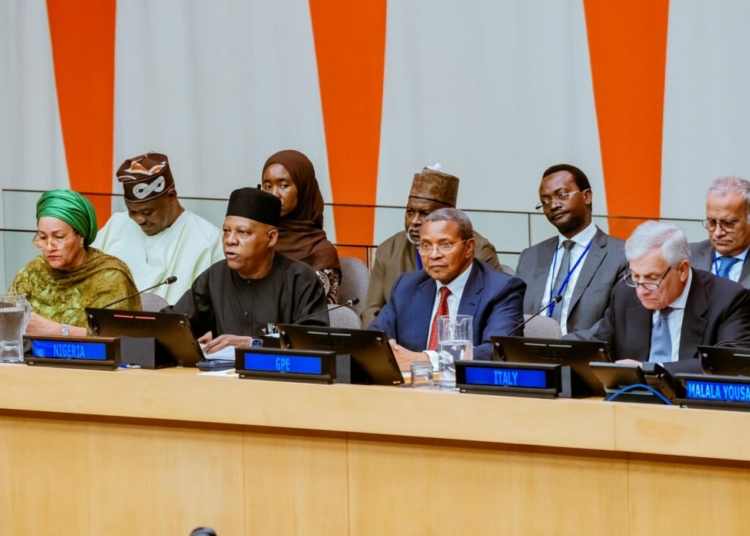
Nigeria and Italy have renewed their partnership with the Global Partnership for Education (GPE) as part of an international campaign aimed at raising $5 billion to expand education financing in developing countries.
The partnership was highlighted at a high-level education financing event held in New York on the sidelines of the 81st United Nations General Assembly. The meeting, themed “A New Era for Education Financing,” brought together government leaders, development partners and education advocates to examine new ways of closing the global education funding gap.
President Bola Ahmed Tinubu, in a video message, said the GPE initiative was consistent with Nigeria’s efforts to improve learning outcomes by expanding access to education and strengthening the capacity of teachers.
Representing the President at the event, Vice President Kashim Shettima described education as a strategic investment in Nigeria’s economic and social development rather than a peripheral government expense.
Shettima said the administration had increased funding for education since taking office in 2023 while pursuing reforms covering basic education, foundational learning, tertiary education and technical skills.
He also highlighted the Nigerian Education Loan Fund as part of efforts to broaden access to higher education and strengthen the connection between education, employability and entrepreneurship.
According to the Vice President, the Federal Government is also exploring additional domestic financing options for education. He said President Tinubu had directed that funds recovered by the Economic and Financial Crimes Commission, once legally cleared and no longer subject to litigation, should be considered for transfer to the education loan fund.
He added that the Federal Executive Council had also approved the consideration of unclaimed dividends and dormant funds for education financing, subject to applicable laws and regulatory requirements.
Shettima said these measures reflected Nigeria’s position that domestic resources should remain at the centre of education financing, with international assistance, concessional funding, philanthropy and innovative financing serving as complementary sources.
He pointed to Nigeria’s collaboration with the World Bank and GPE under the HOPE-EDU programme, which is projected to benefit about 29 million children and 500,000 teachers across the country.
The Vice President said the proposed $5 billion GPE campaign could help partner countries attract additional resources for education, particularly at a time when development assistance is under pressure.
He argued that declining aid levels require countries and international institutions to make more strategic use of available resources, combining domestic commitments with multilateral partnerships to generate greater investment.
Shettima also said Nigeria’s rapidly growing young population could become a major economic advantage if young people are equipped with quality education, relevant skills and meaningful opportunities.
He thanked the Italian government and GPE for working with Nigeria on the campaign, stressing that Nigeria’s participation was intended to demonstrate its own commitment to education investment while encouraging greater international support.
Italian Prime Minister Giorgia Meloni, in a video address, commended Nigeria’s efforts to improve education and called for stronger international action to reverse declining investment in education across developing countries.
UN Deputy Secretary-General Amina Mohammed also urged governments to make education a priority in their national decisions. She called on international financial institutions to help countries create the fiscal space required to improve education systems, particularly through better teacher training and support.
Former Tanzanian President and Chair of the GPE Board of Directors, Jakaya Kikwete, said increased education financing was essential to addressing the widening gap between available resources and the needs of developing countries.
He noted that education plays a central role in advancing human rights, peace and security, while stressing the need for stronger systems capable of delivering measurable results.
Education activist Malala Yousafzai called for greater cooperation among governments and international organisations, arguing that combining resources and expertise can produce broader results than isolated interventions.
She also urged governments and multilateral institutions to increase support for gender equality in education and respond more effectively to the educational needs of girls, particularly in developing countries.
At the event, governments and development partners announced financial commitments intended to support education programmes benefiting hundreds of millions of children worldwide.
Italy pledged €50 million to support GPE programmes and interventions, reinforcing its role alongside Nigeria in the international campaign to mobilise additional financing for education.
The discussions underscored a growing emphasis on combining domestic investment, international cooperation and innovative funding mechanisms to address the global education financing shortfall.