

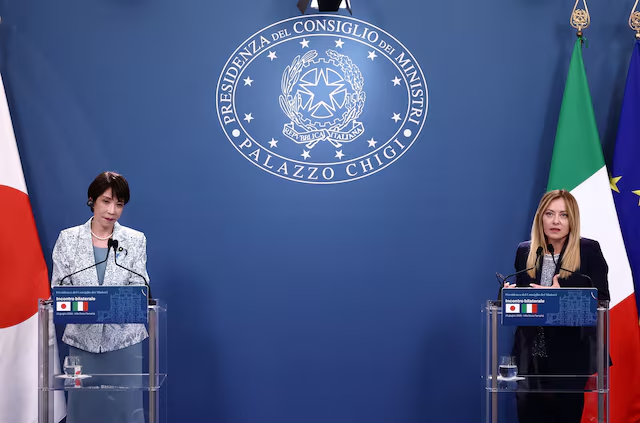
Japanese Prime Minister Shigeru Ishiba has expressed support for Italy’s ambitious plan to construct a bridge linking the island of Sicily to mainland Italy, emphasizing the potential role of Japanese investment and engineering expertise in one of Europe’s most debated infrastructure projects.
The endorsement came during high-level discussions between Japanese and Italian officials, as both countries explored opportunities to deepen economic cooperation, infrastructure development, and foreign investment partnerships.
The proposed bridge, which would span the Strait of Messina, has long been considered one of the most ambitious engineering projects in Europe. If completed, it would create a permanent road and rail connection between Sicily and mainland Italy, significantly reducing travel times and boosting economic activity in southern Italy.
A Project Decades in the Making
The idea of connecting Sicily to the Italian mainland has been discussed for decades, with multiple governments proposing and suspending plans due to financial, environmental, and technical concerns.
Supporters argue that the bridge would transform transportation networks, improve trade and tourism, create thousands of jobs, and stimulate economic growth in one of Italy’s less-developed regions.
However, critics have repeatedly questioned the project’s enormous cost, environmental impact, and long-term economic viability. Concerns have also been raised about seismic risks, as the area sits near one of the Mediterranean’s most active earthquake zones.
Despite these challenges, the current Italian government has renewed efforts to move the project forward, describing it as a strategic investment in the country’s future.
Japan Signals Interest in Major Infrastructure Investment
Prime Minister Ishiba’s support for the bridge highlights Japan’s growing interest in international infrastructure projects and overseas investment opportunities.
Japanese companies are globally recognized for their expertise in large-scale engineering, transportation systems, and advanced construction technologies. Analysts believe Japanese participation could provide both financial backing and technical knowledge needed for a project of this magnitude.
The discussions also reflect broader efforts by Japan to strengthen economic partnerships with European nations at a time of increasing global competition for infrastructure investment and strategic development projects.
Economic Benefits Under the Spotlight
Italian officials have argued that the bridge could become a major driver of economic growth, helping integrate Sicily more closely with the rest of the country and the wider European market.
Improved connectivity is expected to support trade, logistics, tourism, and regional development, while reducing transportation bottlenecks that have historically limited economic activity in southern Italy.
Proponents also point to the potential creation of thousands of jobs during both the construction and operational phases of the project.
For Japan, participation could open new opportunities for investment, technology exports, and deeper economic engagement within Europe.
Environmental and Technical Concerns Remain
Despite renewed momentum, the project continues to face scrutiny from environmental groups, engineers, and opposition politicians.
Critics argue that the funds required for the bridge could instead be invested in upgrading existing transportation infrastructure, improving public services, and addressing other pressing economic challenges.
Environmental advocates have also raised concerns about the potential impact on marine ecosystems and local communities around the Strait of Messina.
In addition, experts continue to debate the technical challenges associated with building a structure in a region known for strong winds, seismic activity, and complex geological conditions.
Strengthening Italy-Japan Relations
Beyond the bridge itself, the discussions underscore growing cooperation between Italy and Japan in areas such as trade, technology, energy, and infrastructure development.
Both countries have increasingly sought to expand economic partnerships amid shifting global supply chains and evolving geopolitical dynamics.
Observers view Japan’s support as a sign of confidence in Italy’s long-term development plans and a reflection of the importance of international collaboration in delivering major infrastructure projects.
While significant hurdles remain before construction can fully proceed, Japan’s backing provides fresh momentum for a project that has spent decades on the drawing board.
Whether the Sicily bridge ultimately becomes reality will depend on securing financing, addressing environmental concerns, and overcoming technical challenges. However, supporters believe the project could become a landmark achievement in European infrastructure and a symbol of international cooperation.
As Italy pushes ahead with its plans and Japan explores potential investment opportunities, the proposed Sicily bridge is once again at the center of global attention.