


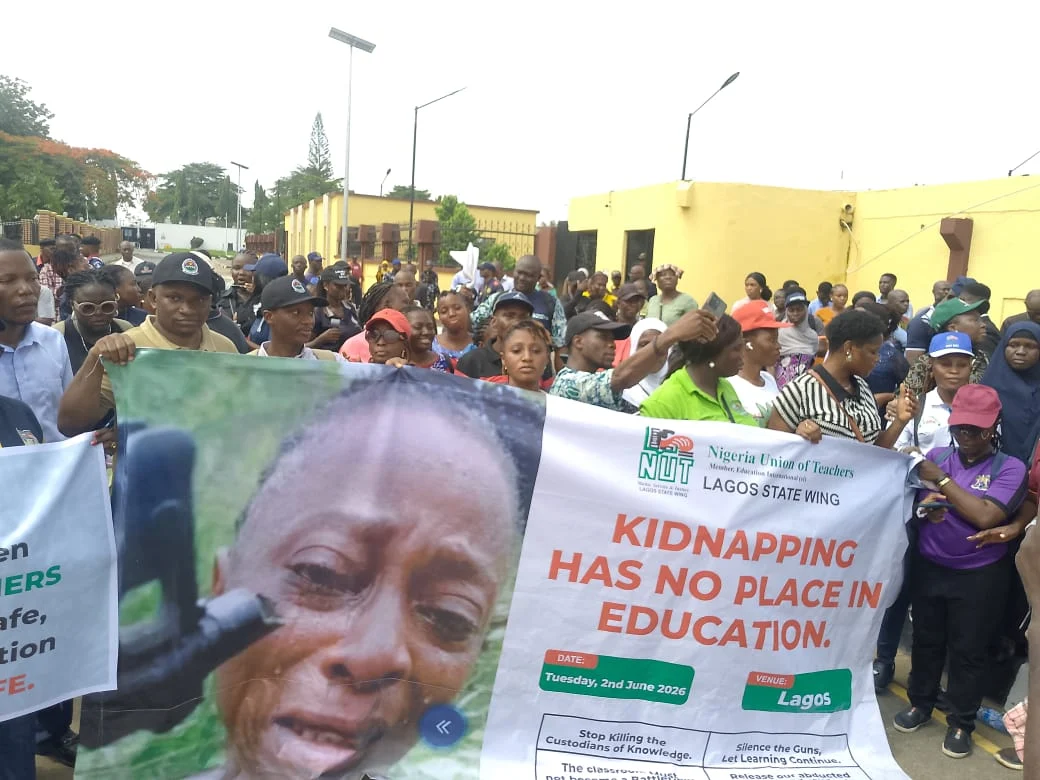
Three weeks after coordinated school attacks in Oyo and Borno, the Federal Government is trapped between releasing captured Ansaru commanders and risking a military rescue that could kill the very children it wants to save.
Three weeks have passed. The classrooms remain empty, The children are not home.
Difficult terrain, fears over the safety of dozens of kidnapped pupils and teachers, and demands by the abductors for the release of detained terrorist commanders have emerged as major obstacles to ongoing efforts to rescue victims of the recent school attacks in Oyo and Borno states.
Multiple Presidency and security sources familiar with the situation say the abductors are demanding the release of high-profile terrorist leaders in exchange for the captives a condition the Federal Government is unwilling to accept despite mounting public pressure for the victims’ freedom.
What began as two simultaneous school attacks on May 15 has metastasized into a full-blown national crisis, exposing the limits of Nigeria’s security architecture, the depth of organized terrorism on its soil, and a government paralyzed by an impossible choice.
Boko Haram insurgents invaded Mussa Primary and Junior Secondary School in Askira-Uba Local Government Area of Borno State, abducting 42 pupils, some of them toddlers. On the same day, another group of gunmen kidnapped 46 persons seven teachers and 39 students from Community High School, Ahoro-Esiele, and Yawota Baptist Nursery and Primary School in Oriire Local Government Area of Oyo State. The dual strike was no coincidence. A Presidency source revealed that the Oyo and Borno school abductions were coordinated and deliberately timed to maximize pressure on the government and strengthen the terrorists’ bargaining position.
The scale and geography of the attacks one in the deep South-West, one in the North-East sent an unmistakable message: these groups have both reach and strategy.
Within days, the horror deepened. By the weekend after the Oyo attack, the abductors had beheaded one of the kidnapped teachers, Mr Michael Oyedokun. Subsequently, the Nigeria Union of Teachers disclosed that two of the abducted teachers in Oyo State had been killed by their captors.
The identity of the group behind the Oyo attack cuts to the heart of why this standoff has dragged on. The deadlock largely stems from demands for the release of suspected Ansaru commanders, Mahmud Muhammad Usman and his deputy, Mahmud al-Nigeri, both of whom are currently in government custody. These are not ordinary suspects. On August 16, 2025, National Security Adviser Nuhu Ribadu announced their capture during a series of high-risk, intelligence-led operations conducted by security and intelligence services between May and July 2025. The arrested men had been on both national and international terror watch lists. Ribadu described the capture as “the most decisive blow against Ansaru since its inception,” identifying Usman who styles himself the “Emir of Ansaru” as the overall coordinator of the group’s nationwide network of terrorist sleeper cells, and the mastermind behind numerous high-profile kidnappings and armed robberies used to finance operations over the past decade. His deputy, al-Nigeri, described by Ribadu as Ansaru’s “Chief of Staff,” leads the Mahmudawa cell operating around the dense forest cover of Kainji National Park, and was trained in Libya between 2013 and 2015 under foreign jihadist instructors from Egypt, Tunisia, and Algeria, specializing in weapons handling and IED fabrication.
A Presidency source laid out the bind plainly: “Yes, the lives of the children must be secured. But they don’t want to release these people because they will become a problem again to the larger society. These are high-level targets who were successfully captured. So, imagine releasing them again.”
On the ground, the operational picture is equally grim. The terrorists came from the Kainji area in Niger State and carried out the Oyo operation from there territory that represents unfamiliar ground for security forces, where there has been no extensive prior operation in the forested areas where the children and teachers are being held. A local official acknowledged that the attackers exploited difficult terrain surrounded by forest reserves and rural settlements, noting that some security personnel sustained casualties during initial confrontations with the armed group.
A second security source confirmed the operational paralysis: “The area is highly forested and unfamiliar. The issue is the sensitivity of any hostage situation. A successful hostage rescue where you have all the hostages alive is very difficult. You don’t want to risk the lives of the children and the teachers in the process.”
A third Presidency source summed up the government’s agonizing position: “I know that the government doesn’t want to negotiate with them. It also doesn’t want to use force that may risk the lives of the people in the forest. The President must have been briefed about it, both Oyo and Borno. It is a coordinated kidnapping.”
Oyo and Borno. It is a coordinated kidnapping.” Punch
The abductors, sources say, are fully aware of this calculation and are exploiting it banking on public outrage to do the work of forcing the government’s hand.
Publicly, the Federal Government is projecting resolve. Speaking at a national security media briefing in Abuja on Thursday, Information Minister Mohammed Idris described the attacks as an assault on Nigeria’s future, and stated that President Tinubu had directed every lawful instrument of the state to be deployed toward securing the victims including the deployment of a specialized rescue team and the authorization of 1,000 forest guards to strengthen security presence across vulnerable communities and forests. Multiple agencies the Armed Forces, DSS, Nigeria Police Force, National Intelligence Agency, Office of the NSA, and the National Counter Terrorism Centre are said to be jointly engaged in intelligence gathering, aerial surveillance, community engagement and search and rescue missions. On recent military gains, Idris cited Operation Hadin Kai’s repulsion of terrorist infiltrations along the Kirawa-Pulka and Ngoshe axes in Borno State, with more than 50 terrorists neutralized. He also noted that roughly 1,000 terrorists, including commanders, were eliminated in the first quarter of 2026, alongside a joint Nigeria-United States-backed operation that disrupted ISWAP logistics networks and rescued 92 civilians near Buratti. Yet none of these gains have produced the one outcome that matters most right now: the children coming home.
UN Resident and Humanitarian Coordinator in Nigeria, Mohamed Malick Fall, called for the immediate and safe release of the abducted schoolchildren and teachers after meeting a delegation from the National Safe Schools Response Coordination Centre in Abuja, describing the incidents as a grave threat to education and child protection.
Fall called for full implementation of the Minimum Standards for Safe Schools, stronger emergency response mechanisms and a data-driven approach to safeguarding schools and at risk children warning that schools had increasingly become targets of attacks in conflict-affected communities. “Schools must remain safe havens for learning and not places of fear,” he said. “Children should never be a target.”
The human cost of the impasse has spilled into the streets and into classrooms. The NUT directed all primary and secondary school teachers in Oyo State to withdraw their services from June 1, 2026, until further notice, citing victims remaining in captivity for more than two weeks under harsh and inhumane conditions while their families endure fear and uncertainty.
The National Association of Nigerian Students aligned with the NLC and NUT’s advocacy, with NANS President Akinteye Babatunde warning that rising insecurity in schools was already creating fear among students and parents, and that education cannot thrive in an atmosphere of fear.
Over 90 civil society organizations have signed a joint statement condemning what they called deep governance failures. Citing data from massatrocities.org, the coalition reported that at least 19,980 people have been killed and 12,362 abducted since May 2023, with about 1,486 security personnel dying in active duty figures they described as alarming for a country not formally at war.
The Christian Association of Nigeria declared June 12 as the beginning of a three day national mourning period, designating June 14 as “Black Sunday” to be observed in churches nationwide in solidarity with victims of insecurity and their families.
Politically, the pressure has reached breaking point. The Peoples Redemption Party called on President Tinubu to resign, with PRP National Chairman Dr Hakeem Baba-Ahmed accusing the administration of failing to translate centralized authority into improved security outcomes, saying “from Generals to toddlers; from Bama to Badagry, no Nigerian is safe under this leadership.
For readers less familiar with the group at the center of this crisis: Ansaru is a splinter faction of Boko Haram with links to al-Qaeda in the Islamic Maghreb, historically operating in the North-West and North-Central, including the forests of Kaduna, Niger and Kogi States, with major enclaves around the Kainji National Park, which straddles Niger and Kwara States and extends to the Republic of Benin. It operates through urban sleeper cells and remote forest bases which is precisely why the terrain around Oriire in Oyo presents such a formidable operational challenge for rescuers.
The group’s capacity to strike simultaneously in Oyo and Borno geographically hundreds of kilometers apart suggests a level of coordination and resources that has caught authorities off guard.
Thirteen days after the attacks, the victims remained in captivity with no contact from the abductors, heightening fears over their safety. As of today, that number is now three weeks and counting.
The Federal Government is caught in a trap partly of its own success having arrested the very commanders the terrorists want freed. Releasing them risks enabling future atrocities. Not releasing them risks the lives of the children being held as leverage.
There are no clean options. There are only children waiting to come home, families who have not slept properly in weeks, and a government that must find a way through.