

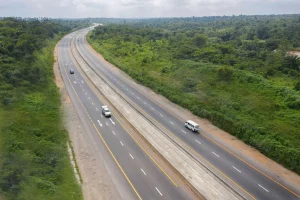
President Bola Ahmed Tinubu has approved the full reconstruction of the Lagos-Ibadan Expressway using reinforced concrete pavement, marking a significant shift in the Federal Government’s approach to the construction and maintenance of one of Nigeria’s busiest highways.
The approval forms part of the administration’s broader infrastructure renewal agenda aimed at improving road durability, enhancing safety, and reducing the long-term cost of maintenance across the country’s strategic transport corridors.
The Lagos-Ibadan Expressway serves as Nigeria’s most critical economic highway, linking Lagos the nation’s commercial hub with Ibadan and several states in the South-West, North-Central, and Northern regions. Every day, thousands of commuters, commercial vehicles, and heavy duty trucks rely on the route to move people and goods across the country.
According to the Federal Government, the decision to use reinforced concrete pavement is intended to provide a stronger and longer lasting road surface capable of withstanding heavy traffic volumes. Unlike conventional asphalt roads, reinforced concrete is expected to require less frequent maintenance while offering greater resistance to weather conditions and the pressure exerted by heavy trucks.
The reconstruction is also expected to improve travel times, reduce traffic congestion caused by deteriorating road sections, and boost economic activities by facilitating smoother movement of goods and services.
Infrastructure experts have long argued that concrete roads, although more expensive to construct initially, often prove more cost-effective over their lifespan because of their durability and lower maintenance requirements.
The Lagos-Ibadan Expressway has undergone several rehabilitation projects over the years due to increasing traffic demand and road wear. The latest approval signals the Federal Government’s intention to deliver a more permanent solution to one of Nigeria’s most strategic transport routes.
The project is expected to create employment opportunities during construction while supporting the government’s efforts to strengthen national infrastructure and improve connectivity across the country.